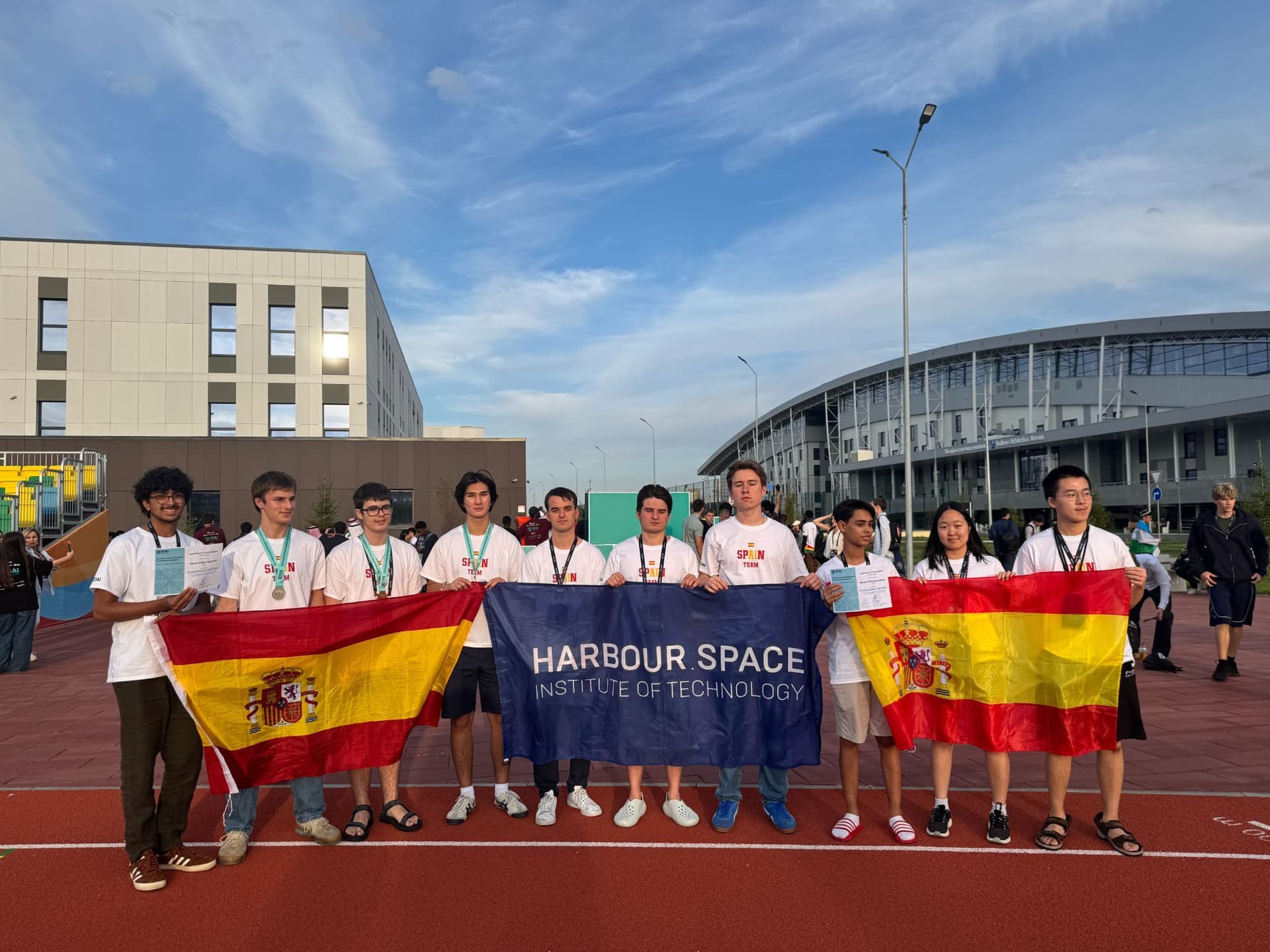
Spain's first IOAI team wins medals after training with Harbour.Space
Spain's first-ever national team at the International Olympiad in Artificial Intelligence (IOAI) won 2 silver medals, 1 bronze, and 3 honourable mentions in Kazakhstan — after training with Harbour.Space.
Spain's first-ever national team at the International Olympiad in Artificial Intelligence (IOAI) won 2 silver medals, 1 bronze, and 3 honourable mentions in Kazakhstan — after training with Harbour.Space.
Spain has never fielded a national team at the International Olympiad in Artificial Intelligence (IOAI) — until this year. And the country's debut couldn't have gone much better: eight secondary school students, prepared through an intensive Harbour.Space training programme, brought home 2 silver medals, 1 bronze medal, and 3 honourable mentions from the 2026 edition of the competition, held in Kazakhstan.
From selection to the podium
Two teams made it through a demanding selection process, months of online training, and an in-person training camp in Tenerife alongside other national delegations. The camp was designed to mirror the real IOAI format as closely as possible, giving students a realistic feel for what awaited them at the competition itself.
That preparation was put to the test in two six-hour individual rounds, where Spain's students competed against 440 participants from 108 countries. The result: Team Spain returned with the following medal breakdown.
🥈 Silver Medal — Henri-Alexander Semenov, American School of Barcelona
🥈 Silver Medal — Tomás Lázaro Danoni, Institut Tiana
🥉 Bronze Medal — Llúria Torras Arcusa, Escola el Cim, Vilanova i la Geltrú
🏅 Honourable Mention — Hector Villanueva Davila, The British School of Tenerife
🏅 Honourable Mention — Varun Aditya, St. George's British School
🏅 Honourable Mention — Roberto Lloréns Dueñas, Escola Professional Salesians de Sarrià
Participant — Ruiwen Zheng, St. George's British School, Barcelona
Participant — Fanxi Xiang, Oak House School
In the team ranking — based on the best four-person score per country — Spain's Team ESP1 placed 26th out of 108 registered countries and territories, with a combined score of 349.9846 and an average of 87.4962 per member. That put Spain ahead of Japan (28th), Belarus (33rd), New Zealand (34th), and Germany (35th), among 82 other nations — a remarkable result for a country competing for the very first time.
A fast-growing global competition
The scale of what Spain's students took part in is worth putting in context. Founded in 2024, IOAI is only two years old, yet it is already the second-largest science olympiad in the world by number of participating countries, trailing only the International Mathematical Olympiad, which has a 67-year head start.
The competition is also growing faster than any other major science olympiad: contestant numbers rose by 77% year-over-year, far outpacing the next-highest growth rate among comparable olympiads, which was just 10% for Linguistics.
In 2026, 108 countries and territories took part, out of 131 IOAI-accredited nations — representing 68% of all UN member states and 90% of the world's population. Europe recorded the highest participation rate of any continent, at 78%, while Africa's IOAI cohort was described by organisers as the largest African community ever assembled at an International Science Olympiad.
The people behind Spain's first team
Spain's debut didn't happen by accident. It was the product of a year of coordinated work by educators, coaches, and volunteers across the country.
Anastasia Goryaynova and Olga Lytvynova served as IOAI Spain's national coordinators, building the pipeline from the ground up — securing the license for Harbour.Space, designing the selection process, and raising awareness among schools nationwide. Svetlana Velikanova supported the initiative from day one, while Patricia Carranza helped connect people and organisations across Spain.
Ogabek Masharipov, who leads Leagues of Code, built the self-paced materials that helped close knowledge gaps before formal training began, and led academic coordination at the Tenerife camp. Maria Kanbina travelled with the team to Kazakhstan as the on-site observer.
Team leaders Artem Seleznev and Danis Dinmukhametov — a 2025 IOAI gold medalist — along with coaches Ivan Zagorulko, Oleg Drokanov (also a 2025 IOAI gold medalist), and Vladimir Arkhipov, were responsible for getting the students competition-ready.
The effort also drew support from national team coaches who joined the Tenerife camp to share their expertise, including Vetit Kanjaras, Vladimir Kirill Bickov, Fiodar Prystauka, and Luka Darsalia, as well as from partner organisations including NABSS, EPIC (Escoles Privades Independents de Catalunya), Universidad Europea de Tenerife, EduSpace, and the Parque Científico y Tecnológico de Tenerife.
Alejandro Vivero Puga, who was himself trained by Harbour.Space before securing Spain's first-ever gold medal at the IOI finals in 2024, joined the effort as an ambassador for the programme.
A foundation for the future
For a country competing at IOAI for the first time, finishing 26th out of 108 nations — ahead of established delegations like Japan and Germany — is a strong signal of what's possible. With the training pipeline, selection process, and coaching structure now in place, Spain's first IOAI cohort looks less like a one-off achievement and more like the starting point for what comes next.
Thanks for reading
If you're interested in further growth, take a look at our website to learn what your future could look like at Harbour.Space. Lastly, get in touch with us at hello@harbour.space to let us know your thoughts!