Math207
Calculus 2
Faculty
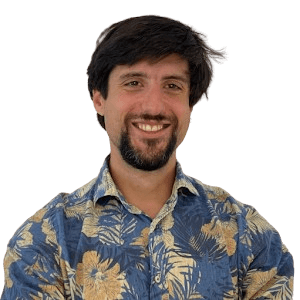
Andrea Serio
Data Scientist & Ph.D. in Mathematics
Course length
Duration
Total hours
Credits
Language
Course type
Fee for single course
Fee for degree students
Skills you’ll learn
Overview
This course bridges single-variable mathematical analysis with multivariable differential and integral calculus, infinite series, differential equations, and constrained optimisation tailored specifically for Computer Science, Data Science, and Quantitative disciplines. In the first module, students explore infinite series, power series, and local Taylor polynomial expansions with asymptotic error bounds. The course then transitions to multivariable functions, focusing on partial derivatives, the steepest ascent properties of gradient vector fields, and double integration over general domains to compute surface areas, volumes, and field averages. The final module addresses dynamic modeling and decision-making through first-order separable differential equations, logistic growth stability, and unconstrained and constrained optimisation using Lagrange multipliers.
Combining theoretical rigour with practical problem-solving, the course emphasises foundational proofs alongside computational mechanics. Students complement formal mathematical reasoning with interactive visualisation tools and numerical computing notebooks (such as Python and GeoGebra 3D) to analyse 3D surfaces, evaluate complex integrals, and simulate dynamic systems.
Learning highlights
- Master the convergence analysis of infinite series, power series, and function approximations using Taylor and Maclaurin series expansions.
- Gain proficiency in multivariable differentiation, including partial derivatives, directional derivatives, and gradient vectors.
- Apply multivariable calculus to unconstrained and constrained optimisation problems using Hessian matrices and Lagrange multipliers.
- Master double integration techniques over general domains to compute surface areas, volumes under surfaces, and multivariable field averages.
- Understand first-order differential equations and analyse qualitative phase-line stability in non-linear dynamical models.
- Use computational and visual tools to render multivariable surfaces, simulate series approximations, and explore dynamic system models.
Course outline
15 classes
Snow Summit
Snow Summit
Infinite Series & Convergence Tests
* Sequences of functions and definition of infinite series.
* Positive series comparison tests, ratio/root tests, sign-alternating series, and absolute vs conditional convergence.
Power Series
Power series expansion, radius and interval of convergence, boundary endpoint analysis.
Taylor & Maclaurin Series
Proof of Taylor's Theorem with Peano and Lagrange remainder forms.
Series Workshop & Quiz
* Group problem-solving on functional approximations, numerical series,
* Quiz session.
Multivariable Functions & Derivatives
* Functions of several variables,
* Multivariable limits, continuity, and partial derivatives.
Directional Derivatives & Gradients
* Geometry of scalar fields, directional derivatives, gradient vector,
* Proof of steepest ascent.
Unconstrained Optimisation
* Critical points, multivariable Taylor expansions.
* Hessian matrix, and second-derivative classification.
Midterm Examination
Assessment covering infinite series, power series, and multivariable differential calculus.
Constrained Optimisation
Optimisation with equality constraints and proof of Lagrange multipliers.
Double Integrals
* Partial Fractions Refresher.
* Double integrals over rectangular and general domains, Fubini’s theorem, and order of integration.
Applications of Double Integrals
Computing surface areas, volumes under surfaces, and multivariable average values.
First-Order Differential Equations
Introduction to ODEs, mathematical modeling, and analytical solutions to separable differential equations.
Non-linear ODEs & Stability
Logistic growth modeling, autonomous ODEs, equilibrium points, and qualitative phase-line stability.
Final Exam
Assessment covering the full course content.
Prerequisites
Core Mathematical Competencies:
- * Single-Variable Differential Calculus: Mastery of sequence and function limits, continuity, differentiation techniques (chain rule, implicit differentiation), local optimisation, and application of the Mean Value Theorem.
- * Integral Calculus: Proficiency in evaluating indefinite and definite integrals using core techniques (integration by substitution, integration by parts) and applying the Fundamental Theorem of Calculus.
- * Asymptotic Analysis & Series Fundamentals: Understanding of function growth rates using Big-O and little-o notation, alongside constructing basic Taylor and Maclaurin polynomial expansions with remainder bounds.
- * Algebraic & Proof Literacy: Fluency in high-school algebra, trigonometry, exponential and logarithmic functions, Cartesian coordinate geometry, and basic proof techniques (e.g., mathematical induction, direct proof).
Computational Skills:
- * Basic Python programming literacy (working with NumPy and Matplotlib) or familiarity with interactive plotting tools (GeoGebra, Desmos) for numerical experiments and visual function analysis.

Methodology
The course follows a 3-hour daily session structure over 3 weeks (13 teaching sessions + 1 exam session):
- * Lectures & Interactive Seminars (60%): Interactive presentation of core theorems, intuitive geometric explanations, and live problem-solving on the whiteboard.
- * Hands-on Workshops & Problem Sets (30%): Collaborative in-class practice sessions where students solve problem sheets with immediate instructor feedback. Optional Python (NumPy, Matplotlib) and GeoGebra demonstrations are provided for visual modeling and numerical intuition.
- * Self-Study & Individual Homework (10%): Daily practice assignments reinforcing theoretical proofs, series convergence tests, and multivariable computational techniques.
Grading
Apply for this course
Calculus 2
by Andrea Serio
Total hours
42 Hours
Dates
Feb 02 - Feb 19, 2027
Fee for single course
€1,500
Fee for degree students
€750
How to secure your spot
Complete the form below to kickstart your application
Schedule your Harbour.Space interview
If successful, get ready to join us on campus
FAQ