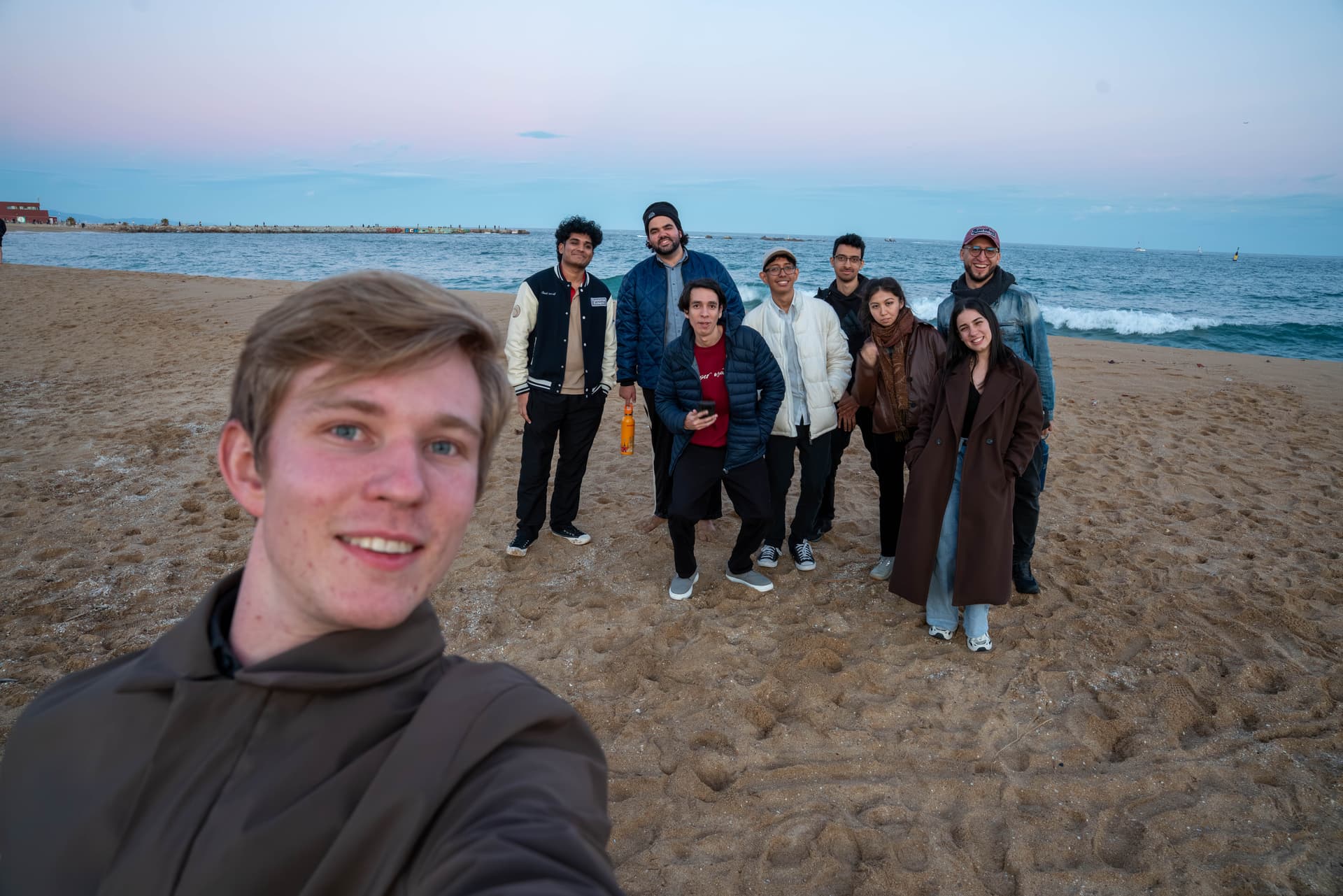
How We Won the Hea Hackathon 2026
Earlier this year, Harbour.Space hosted the Hea Hackathon, a two-day competition where teams built AI prototypes capable of detecting early health risks from self-reported data.


Technical Product Manager
Earlier this year, Harbour.Space hosted the Hea Hackathon, a two-day competition where teams built AI prototypes capable of detecting early health risks from self-reported data.
Earlier this year, Harbour.Space hosted the Hea Hackathon, a two-day competition where teams built AI prototypes capable of detecting early health risks from self-reported data. Hea's core idea is compelling: use self-reported health parameters to predict potential future health issues before a formal diagnosis is needed, catching diseases early, before symptoms become apparent enough to require a doctor's visit. That was the goal. That's what we built.
The dataset and the Challenge
We had access to the RAND Health and Retirement Study, a dataset that tracks over 40,000 people across 30 years through regular surveys covering self-rated health, mood, sleep, physical activity, lifestyle, and new diagnoses since the last check-in. Like every team, we used this data to train our model. What set teams apart was what they did with it. Teams were evaluated across five dimensions by domain experts, and the top four advanced to a live Q&A round.
What we built
Our project is a conversational health companion called Hea. You talk to it about how you're feeling, and behind the scenes it runs specialised models to assess your risk across three areas: metabolic, psycho-emotional, and cardiovascular.
The LLM in the system never makes predictions itself. It acts as a coordinator: deciding which tools to call, translating results into plain language, and adjusting its tone based on how confident the underlying models are. The actual risk assessment comes from LightGBM models trained on 312 features engineered from the longitudinal data.
The raw survey gives you things like BMI, mood score, and activity level at each time point. Feature engineering means computing new inputs from those — how fast someone's BMI is trending over several years, how volatile their mood has been, or whether their sleep and physical activity are declining simultaneously. These patterns are often more predictive than any single measurement. We used SHAP to trim those down to the 120 most relevant features per outcome, and isotonic calibration to make the output probabilities trustworthy. The whole pipeline runs on device with zero inference cost.
We also built a native iOS app with Apple Watch integration to show how this could work as a real product, though the core of our submission was the ML pipeline and the reasoning behind it.
The demo that said Everything
For our demo, we used a real person from the dataset: a 62-year-old woman who rated her own health as "very good" with no known conditions. Our model flagged her cardiovascular risk well above threshold. When we checked the follow-up data from two years later, she had been diagnosed with hypertension.
A hidden signal, caught before she was aware of it. That's exactly what Hea is supposed to do.
What we learned in 48 hours
We went through three full iterations in two days. Early on we experimented with Neural CDEs and TabPFN, more exotic architectures for temporal and tabular data. They were competitive, but a well-tuned gradient boosting model with good feature engineering beat both.
The clearest takeaway: the features mattered more than the architecture. Small, calibrated models also turned out to be a natural fit for a competition that scores interpretability and rigor. Judges could inspect every feature weight and SHAP value. That they also run on any phone at no cost was a nice bonus.
Building a full product in under 48 hours mostly teaches you what to cut. Everything that shipped was something we decided not to remove.
What comes next
We were genuinely surprised to learn that Hea are working on a scientific publication on self-reported health predictions, and that our work will be included in it. Not a bad outcome for two days of work.
Thanks for reading
If you're interested in further growth, take a look at our website to learn what your future could look like at Harbour.Space. Lastly, get in touch with us at hello@harbour.space to let us know your thoughts!