How Barcelona Inspired Robin's OFFF Festival Project
When your university campus is a UNESCO World Heritage city, inspiration has a way of finding you.

Social Media Specialist
When your university campus is a UNESCO World Heritage city, inspiration has a way of finding you.
There is a particular kind of learning that no syllabus can fully plan for. It happens when you step outside the classroom and the city itself becomes your brief. For Robin Grossniklaus, a student in the Interaction Design programme at Harbour Space University, that moment in Barcelona, walking through neighbourhoods dense with Gaudí's architecture, phone in hand, collecting visual references without any particular destination in mind.
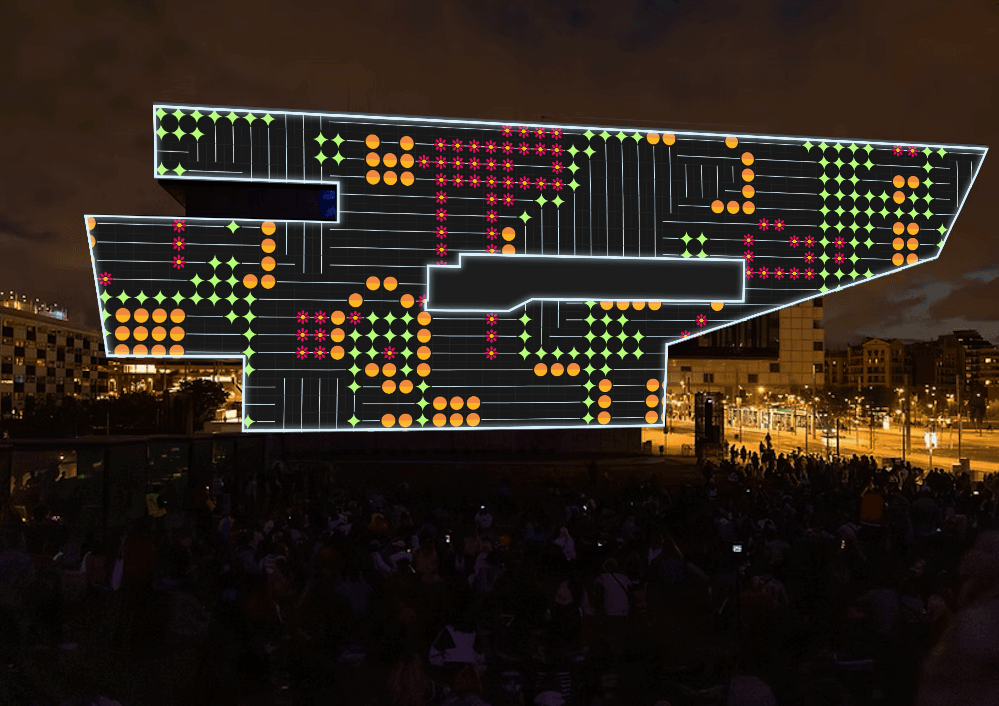
Those walks led to a project. That project has now been selected for The Screen 2026, the large-scale video mapping show at Disseny Hub Barcelona, part of OFFF Barcelona Festival, one of the world's most prestigious festivals for design, motion, and digital creativity. His piece, Digital Trencadís, will be projected onto the building's facade in front of thousands of people across three nights this April.
It is the kind of opportunity that sounds almost too good to be true. But for students studying design in Barcelona, it turns out to be entirely within reach.
What Is OFFF Festival?
OFFF Festival (One Feed For Future) is an international festival dedicated to post-digital culture, creativity, and design. Founded in Barcelona in 2001, it has grown into one of the most respected gatherings for motion designers, visual artists, creative directors, and digital practitioners globally. Every edition brings together leading voices in the field alongside emerging talent, for three days of talks, workshops, and large-scale exhibitions. OFFF Festival 2026 takes place April 16–18 at Disseny Hub Barcelona, and The Screen, a video mapping show projected onto the building's iconic facade, is one of its most anticipated public moments.
Choosing Barcelona, Choosing Possibility
Robin grew up in Switzerland and, after completing a four-year apprenticeship as an Interactive Media Designer at a design agency in Biel/Bienne, working on real client projects, designing interfaces, and developing motion animations, he spent a further year in the industry before making a deliberate decision: to go somewhere that would push him further.
"Moving here was an important step for me," he says. "I've always had the goal of exploring beyond Switzerland and, eventually, beyond Europe."
Barcelona was not just a change of scenery. It was a change of context, the kind of environment where culture, architecture, public space, and creative industry overlap in ways that are genuinely difficult to find elsewhere. For a student of Interaction Design, that overlap is not incidental. It is the material.
Robin still travels light, often with just a backpack and a surfboard, and brings that same openness to his creative practice. Before his design career, he was a semi-professional freeskier competing internationally between the ages of 14 and 17. The discipline that shaped him then still shows up in how he works now.
More recently, that drive has also taken an entrepreneurial turn: Robin is a co-founder and Digital Experience Designer at Brandup, a Switzerland-based digital agency helping businesses grow through branding, web design, performance marketing, and content creation.
When the City Gives You Your Brief
The Interaction Design programme at Harbour Space is built around the idea that real learning happens through real problems. Students work with professional tools, industry mentors, and live briefs, and they do so in a city that is, by any measure, one of the richest visual and cultural environments in Europe.
For Robin, that environment became the starting point for Digital Trencadís. The concept emerged simply: from walking, looking, and asking what Gaudí's mosaic language, the trencadís technique built from shards of broken ceramic, might look like if reinterpreted through minimal digital geometry.
The animation begins with a visual scan of a building, revealing its underlying structure. Geometric shapes gradually emerge and assemble, behaving like simplified tiles, building rhythm and texture. Colour enters slowly, bringing energy to what starts as something spare and ordered. Then, toward the end, the composition collapses and fades to black, a reflection on cycles: how things emerge, evolve, and eventually dissolve.
Technically, Robin built the piece using Figma and Adobe Illustrator, using the Overlord plugin to move assets into After Effects, where the motion was developed and the piece finalised.
See It, It'S free, and it'S This Week
The Screen 2026 brings together 285 artworks from creators around the world into a single collaborative mapping experience with integrated sound design. Robin's Digital Trencadís will be among them, projected on the facade of Disseny Hub Barcelona at Plaça de Santiago Pey.
The show runs April 16–18, 2026, from 21:00 to 23:00, with two full screenings each night (21:00–22:00 and 22:00–23:00), each featuring a different programme.
You can see Robin's project on Thursday night only.
Entry is free.
Robin's story is a good reminder of what studying in the right city can make possible. The brief was always there, written into the streets. Harbour Space gave him the tools to respond to it.
Thanks for reading
If you're interested in further growth, take a look at our website to learn what your future could look like at Harbour.Space. Lastly, get in touch with us at hello@harbour.space to let us know your thoughts!